Soft Robots: How Flexible Machines Are Changing Medicine, Manufacturing and Rescue Work
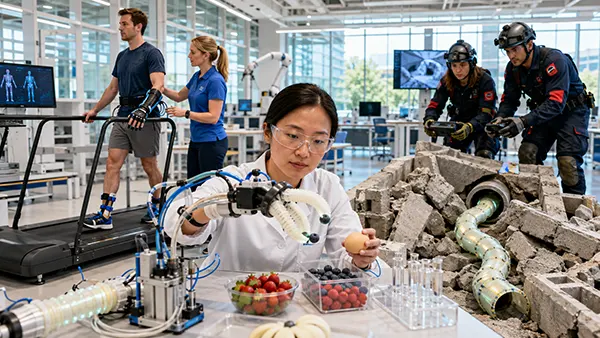
Most conventional robots are built from rigid links, metal joints and electric motors, which makes them accurate and powerful but not always suitable for close contact with people, fragile products or unstable surroundings. Soft robotics takes a different approach. These machines use flexible structures that can bend, stretch, twist or compress when they meet an obstacle. By 2026, soft robots are assisting stroke rehabilitation, handling fruit and other delicate goods, guiding experimental medical instruments and entering gaps beneath collapsed structures. The field still faces significant problems involving durability, power, sensing and control, but practical products and field-tested prototypes already show where flexible machines can provide advantages that rigid designs cannot easily match.
What Makes a Robot Soft and Why It Matters
A soft robot does not need to be entirely soft. Some machines are made mainly from silicone, rubber, fabric or other flexible materials, while others combine a compliant outer body with rigid motors, cables, pumps, sensors or electronic components. The defining feature is that the working part of the robot can deform substantially rather than moving only through fixed mechanical joints. This compliance allows a gripper to wrap around an irregular object, a wearable device to follow the movement of a person’s leg or a mobile robot to squeeze through a space narrower than its normal body.
Designers commonly use elastomers, silicone rubbers, knitted textiles, flexible plastics and, in experimental devices, hydrogels or materials containing magnetic particles. Movement may be produced by pumping air into internal chambers, pulling embedded cables, circulating liquid, applying an electric field or controlling the robot with an external magnet. These methods act like simplified artificial muscles. For example, inflating one side of a silicone chamber causes it to expand more than the other side, making the structure bend. Several chambers can then be controlled separately to produce gripping, crawling or twisting movements.
The main benefit is not softness for its own sake but the ability to adapt physically to uncertain conditions. A rigid gripper normally requires accurate information about an object’s position, size and shape. A compliant gripper can compensate for small errors by changing shape around the object. The same principle helps a medical device follow the contours of the body and allows a rescue robot to pass around pieces of debris. Softness can also reduce impact forces during contact, although it does not automatically make a robot safe. Hard internal components, excessive pressure, control errors or material failure can still create risks.
How Soft Robots Move, Sense and Adapt
Pneumatic actuation remains one of the most widely used approaches because air-filled chambers are relatively light and can produce large movements. A compressor or pump sends air into selected sections of the robot, causing them to lengthen, shorten or curve. Pneumatic systems are well suited to grippers, wearable supports and inflatable mobile robots, but their pumps, valves and tubes can add weight and limit portability. Hydraulic systems use liquid instead of air and can provide greater force, while cable-driven devices place the motor away from the flexible part and transfer movement through thin lines.
Sensing is more difficult in a soft structure than in a rigid machine. A conventional robot can measure the angle of each joint, but a soft arm may bend at almost any point along its body. Researchers therefore embed stretchable electrical tracks, pressure sensors, optical fibres or small inertial sensors into flexible materials. Cameras may also track the robot’s shape from outside. These systems help determine whether a gripper has secured an object, whether an exosuit is moving in time with its wearer or whether a rescue robot has turned around an obstacle.
Control remains one of the field’s central challenges in 2026. Flexible materials can behave differently as they warm up, age or experience repeated loads. Two apparently identical silicone components may not bend in precisely the same way, and a robot’s response can change after thousands of cycles. Computer models and machine-learning methods can compensate for some of this variation, but many practical systems avoid unnecessary complexity. They are designed for a clearly defined task, such as supporting an ankle during walking or gripping food products within a known size range. This task-specific approach is currently more reliable than attempting to build one highly flexible machine capable of performing every type of work.
Soft Robotics in Medicine and Rehabilitation
Medicine is a natural area for soft robotics because the human body contains curved surfaces, delicate tissues and joints that rarely move along a single fixed path. A flexible medical device can spread pressure over a larger area and conform more closely to the patient than a rigid frame. Current applications include rehabilitation garments, assistive gloves, flexible catheters, steerable endoscopes and experimental tools for holding tissue during minimally invasive procedures. Some of these systems are already used clinically, while many others remain laboratory prototypes that require further testing.
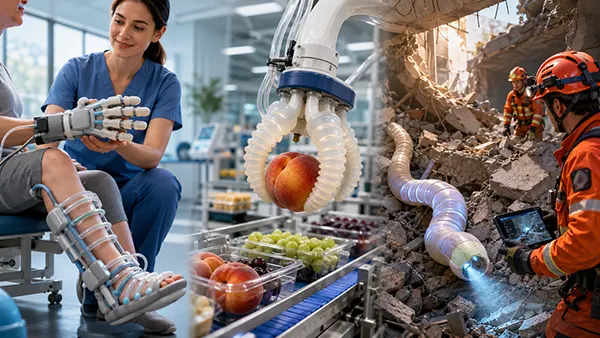
A notable commercial example is the ReStore Exo-Suit, currently supplied by Lifeward for supervised stroke rehabilitation. The lightweight device uses fabric attachments, sensors and cable-driven assistance to support ankle movement while a patient walks. It helps with dorsiflexion, which lifts the front of the foot, and plantarflexion, which contributes to forward propulsion. The US Food and Drug Administration cleared the system for use in rehabilitation institutions in 2019, and it remains part of Lifeward’s product range in 2026. It is operated by trained therapists rather than used as an unsupervised personal mobility aid.
Flexible surgical tools represent another important direction, although their development is less mature. Soft or highly compliant catheters can potentially turn through branching blood vessels, airways or ducts with less force against surrounding tissue. Researchers are also working on magnetic steering, which allows a clinician to guide an instrument without placing a conventional motor at its tip. A 2026 research paper described a modular magnetic soft robotic catheter with an outer diameter of 1.47 millimetres, designed to combine steering with several possible functions. Such work demonstrates technical progress, but it should not be confused with a device already approved for routine treatment.
From Wearable Assistance to Minimally Invasive Treatment
Soft wearable robots are intended to assist movement without enclosing the user in a heavy mechanical frame. Textile straps can transfer force to the hips, knees, ankles, shoulders or back while leaving most joints free to move naturally. In rehabilitation, sensors identify the phase of a walking cycle and the device applies assistance at a selected moment. This support can help a therapist conduct more intensive and repeatable training. Similar research is examining garments for people with Parkinson’s disease, workplace back-support suits and gloves that help users practise hand movements after neurological injury.
Inside the body, flexibility can make an instrument easier to guide through narrow or curved routes. Soft tips may bend around tissue rather than forcing it aside, and compliant grippers may hold slippery organs without relying on concentrated pressure from hard jaws. However, these benefits introduce demanding engineering requirements. Medical tools must remain predictable even when exposed to body fluids, temperature changes and repeated sterilisation. They must also be made from suitable biocompatible materials and provide the clinician with clear information about their position and the forces applied to tissue.
Clinical adoption depends on more than successful laboratory demonstrations. Manufacturers must prove that a device can be produced consistently, cleaned or sterilised correctly and operated safely by healthcare staff. Trials must establish whether it improves patient outcomes rather than simply showing that it can move. Maintenance, training and cost also matter because hospitals need equipment that fits existing clinical routines. For this reason, relatively focused products such as rehabilitation exosuits are further along than autonomous soft surgical robots. The latter remain a long-term research goal rather than a standard feature of operating theatres in 2026.
Manufacturing and Rescue Work: Practical Uses Beyond Healthcare
Manufacturing provides some of the clearest commercial uses of soft robotic components. Food, cosmetics and pharmaceutical businesses often handle objects that vary in shape or can be damaged by a conventional metal gripper. Flexible fingers can adapt to fruit, baked goods, packaged products and irregular containers without requiring a separate rigid tool for every item. They can also reduce bruising or surface marks when properly configured. These qualities are particularly useful on production lines where product dimensions vary naturally or several types of item pass through the same handling station.
Current industrial products demonstrate that soft gripping has moved beyond research prototypes. Festo added the hygienic HPSX adaptive soft gripper to its commercial range, presenting it in late 2025 for delicate and irregular products in food, pharmaceutical and cosmetics work. OnRobot also continues to offer a food-grade Soft Gripper with interchangeable silicone-moulded gripping elements. These tools are normally attached to conventional industrial or collaborative robot arms. The arm supplies accurate positioning, while the flexible end component provides the physical adaptation needed to pick up the product.
Soft components can also support closer cooperation between workers and automated equipment, but careful risk assessment remains essential. A flexible arm or gripper may cause less severe contact than a heavy rigid mechanism, yet the complete machine may still include a powerful robot arm, moving load or hard mounting parts. Industrial users must also consider production speed, payload, cleaning procedures and material wear. A soft gripper that performs well with strawberries may not be suitable for sharp metal components or heavy boxes. Successful installations therefore match the material and gripping method to a specific product and operating environment.
The Obstacles Between Promising Prototypes and Routine Use
Search-and-rescue work shows a different advantage of flexible construction. After an earthquake, explosion or structural collapse, rescuers may need information from spaces that are too narrow or unstable for a person, wheeled robot or tracked vehicle. SPROUT, developed by MIT Lincoln Laboratory and the University of Notre Dame, is a recent example. The Soft Pathfinding Robotic Observation Unit uses an air-inflated tube that extends from its tip, allowing it to move through gaps without dragging its entire body across debris. A camera and motion sensors can provide responders with information and help map routes beneath rubble.
Growing robots can turn around corners and pass through irregular routes while applying relatively little force to unstable surroundings. They may eventually carry microphones, thermal sensors, gas detectors or communication lines to help locate survivors and assess hazards. However, real disaster sites are far harsher than controlled demonstrations. Broken glass, hot surfaces, water, dust and sharp concrete can puncture flexible materials or obscure cameras. Rescue equipment must also be transported quickly, assembled under pressure and operated by teams who cannot spend hours recalibrating an experimental machine.
The wider future of soft robotics will depend on improvements in durability, power supply, sensing and repeatable manufacturing. Flexible actuators often produce less force or respond more slowly than electric motors of a similar size, while pumps and external control equipment can reduce the benefits of a lightweight body. Materials may stretch permanently, develop leaks or respond differently after extensive use. By 2026, the most credible path is not the wholesale replacement of rigid robots. It is the creation of hybrid machines that combine accurate conventional hardware with flexible parts wherever adaptation, gentle contact or movement through confined spaces provides a measurable practical benefit.