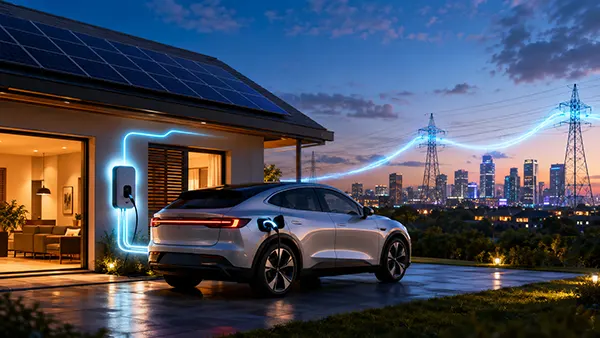
Vehicle-to-Grid in 2026: How Electric Cars Are Starting to Power Homes and Cities
Electric cars are increasingly being treated as more than vehicles that simply draw electricity from a socket. In 2026, a growing number of models and charging systems can move energy in both directions, allowing part of the electricity stored in an EV battery to be used by a home, a building or, in suitable markets, the wider electricity grid. This approach is known as bidirectional charging, while Vehicle-to-Grid, or V2G, refers specifically to sending energy from the vehicle back into the grid. The idea is simple: most cars spend many hours parked, so their batteries can potentially support the energy system during those periods without preventing the driver from using the vehicle when needed. The technology is now moving from small demonstrations towards early commercial use, although compatibility, local rules, charger availability and electricity tariffs still vary considerably.
How Vehicle-to-Grid Turns an EV Battery into a Two-Way Energy Source
A conventional electric car is charged in one direction. Electricity moves from the grid through a charger and into the battery, where it remains until the driver uses it for a journey. Bidirectional charging adds the ability to reverse that flow. A compatible car can still charge normally, but it can also release some of its stored electricity through suitable equipment. The driver does not have to give up control of the battery: modern systems can keep a chosen minimum charge level, protect the range needed for the next trip and limit when energy is exported.
Several closely related terms are used in 2026. Vehicle-to-Home, or V2H, means using the EV battery to supply a house. Vehicle-to-Building, or V2B, applies the same principle to a larger property such as an office or commercial site. Vehicle-to-Load, or V2L, usually means powering individual appliances or tools directly from the vehicle. Vehicle-to-Grid goes one step further because exported electricity enters the public electricity network and can be used as part of wider grid balancing. A car that supports V2L or V2H is therefore not automatically capable of full V2G operation.
The communication needed for wider V2G use is becoming more standardised. ISO 15118-20, first published in 2022 and amended again in 2026, defines communication requirements for bidirectional power transfer between compatible electric vehicles and charging equipment. This matters because the car, charger and energy service need to exchange information about charge level, power limits and timing. The standard does not make every EV and every charger interchangeable overnight, but it provides a common technical foundation that manufacturers and charging companies can use as new products are introduced.
What Actually Happens When the Car Sends Electricity Back
From the driver’s point of view, bidirectional charging can be fairly straightforward. The car is plugged in at home or another suitable location, and the owner sets practical limits such as the time the vehicle must be ready and the minimum battery level that should remain available. The charging system can then decide when to charge and, where permitted, when to discharge. If cheap or plentiful electricity is available overnight or during a period of strong renewable generation, the battery can take in energy. Later, part of that energy can be used by the home or returned to the grid when demand and prices are higher.
For home use, the EV may act much like a large backup battery. During a power cut, a correctly installed V2H system can isolate the home safely from the public network and supply selected circuits or, depending on the equipment and vehicle, a larger share of household demand. The same battery can also be used without an outage. A household with rooftop solar may charge the car when solar generation is high and use some of that energy later in the evening, reducing the amount of electricity bought from the grid at a more expensive time.
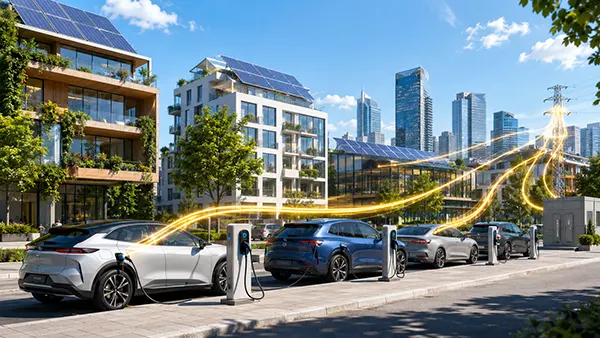
Full V2G adds another layer because the energy is exported beyond the property. In most commercial arrangements, an energy supplier or aggregator coordinates many connected cars rather than treating each vehicle separately. One parked EV cannot change a city’s electricity balance, but thousands of vehicles responding together can reduce demand at a busy time or return power when the grid needs extra support. The owner normally keeps control over departure time and minimum charge, while the energy service works within those limits.
Why V2G Matters for Homes, Renewable Energy and Urban Electricity Networks
The growth of electric transport creates both a challenge and an opportunity for electricity networks. Large numbers of cars charging at the same time can add a significant evening load, particularly in residential areas. At the same time, wind and solar generation do not always match the hours when people use the most electricity. Smart charging already helps by moving charging into quieter periods. V2G can provide additional flexibility because the vehicle is able not only to delay charging but also to release stored energy when the system is under pressure.
This is particularly useful in cities and suburbs where local transformers and cables may face short periods of high demand even if they have enough capacity for most of the day. Instead of every plugged-in EV starting to charge as soon as its owner arrives home, coordinated charging can spread demand across several hours. With V2G, some vehicles can also discharge during a peak and recharge later. The International Energy Agency reported in its 2026 assessment that V2G could help reduce peak demand and, in some situations, limit the amount of future grid reinforcement that would otherwise be needed.
Real-world planning is beginning to attach numbers to that potential. In March 2026, the California Energy Commission reported modelling in which wider use of Vehicle-to-Home could reduce peak residential demand by as much as 5 GW in 2030. Its analysis also estimated average summer bill savings of $262 to $321 for participating drivers in the modelled scenario. These figures are not universal promises for every household, because tariffs, climate, driving patterns and local grid conditions differ, but they show why energy authorities increasingly view EV batteries as a possible part of electricity-system planning rather than as a new source of demand alone.
Home Backup Power and Grid Services Are Not the Same Thing
For many households, backup power is likely to be the most understandable first use of bidirectional charging. A large EV battery can store far more energy than many small household batteries, so keeping the car connected during an outage can provide useful resilience. Some manufacturers already sell V2H equipment for selected models. GM Energy, for example, lists a range of 2026 electric vehicles that can work with its home energy equipment to provide backup electricity to a properly equipped property. This is a genuine use of bidirectional charging, but the energy does not necessarily leave the home and enter the public grid.
V2G is different because the vehicle participates in the electricity market or in grid services. The car may charge when electricity is cheaper and discharge when prices rise, or it may respond to requests that help maintain the balance between supply and demand. Owners can potentially be paid for making this flexibility available. The exact payment model depends on the country and energy company, and revenue is not guaranteed. The IEA notes that current V2G offers use several approaches, including direct payments, reduced charging costs and tariffs in which the supplier manages charging and discharging on the customer’s behalf.
The distinction matters when buying a vehicle or charger. Advertising may use broad phrases such as “bidirectional charging”, but consumers need to know exactly which function is supported. V2L may run a laptop, camping equipment or power tools. V2H may supply a property, particularly during an outage. V2G requires additional communication, approved charging equipment, a suitable grid connection and an electricity arrangement that permits export. In 2026, these functions are still not interchangeable, so checking the specific vehicle, charger and local energy rules is more important than relying on a general bidirectional label.
What EV Owners Should Expect from Vehicle-to-Grid in 2026
V2G is commercially real in 2026, but availability remains limited. The International Energy Agency counted 22 EV models with stated V2G capability, representing less than 1.5% of electric models on the market, although many more vehicles support V2H or V2L. Early commercial V2G offers are concentrated in a small number of countries. The IEA identifies France, the Netherlands and the United Kingdom as markets where the necessary conditions are in place and commercial offers are available. This is an important change from the earlier period when most V2G activity consisted of research projects and restricted trials.
There are also clearer examples of manufacturers bringing the idea into normal consumer products. In April 2026, Renault Group described its Plug Inn powerbox as a bidirectional charging solution combined with a V2G service. In the UK, Octopus Energy and BYD had already announced a consumer V2G bundle in 2025 that combined a compatible BYD Dolphin, a bidirectional charger and a managed electricity tariff. In North America, V2H is currently more visible than full consumer V2G: GM Energy supports home backup with a growing list of compatible 2026 EVs, showing how bidirectional hardware can reach households before grid-export services become equally widespread.
Compatibility remains the main practical issue. A V2G-capable car still needs a charger that can send power in both directions, electrical installation that meets local rules and permission to export where required. In California, for example, customers using equipment to deliver power to the grid must complete the utility interconnection process and receive approval to operate. In the UK, V2G installations are subject to grid-connection requirements, and the July 2026 Clean Flexibility Roadmap says further work is under way to make V2X connections easier and more consistent. Buying a compatible EV is therefore only one part of the process.
Why Adoption Will Be Gradual Rather Than Immediate
The largest obstacle is not the basic idea of sending electricity in both directions; that has already been demonstrated. The harder task is making cars, chargers, homes, utilities and energy services work together reliably across different brands and countries. ISO 15118-20 provides an important common standard, but the IEA says interoperability between current V2G vehicles and chargers remains very limited. Many commercial offers still depend on a specific vehicle, a specific charger and a specific electricity tariff. That makes early V2G practical for some users but prevents the simple mix-and-match experience expected from mature home electrical equipment.
Battery ageing is another concern, but it is more nuanced than the claim that V2G automatically damages an EV battery. Sending energy in and out creates additional cycling, and aggressive or poorly managed use can increase wear. However, battery life is also affected by temperature, average state of charge, charging speed and how deeply the battery is cycled. Research reviewed in 2025 and 2026 shows that careful scheduling and battery management can reduce the extra degradation, while the IEA notes that well-managed V2G can in some cases produce less capacity loss than uncontrolled charging that keeps a battery at a high state of charge for long periods.
For most drivers in 2026, V2G should therefore be viewed as an emerging energy feature rather than a standard reason to buy any electric car. The most useful first step is to separate the functions that are already available from those that still depend on local market support. V2H can already provide practical home resilience in selected vehicle and charger combinations, while full V2G is beginning to create commercial opportunities in a smaller number of markets. The direction is clear: as compatible vehicles increase, standards are implemented more consistently and energy rules adapt to two-way charging, parked electric cars are likely to become a more active part of household and urban electricity management.