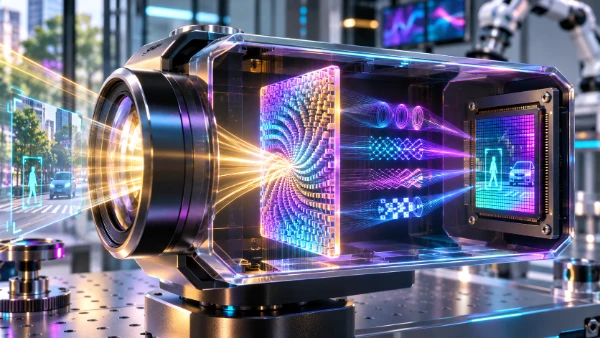
Optical Metasurfaces for Computer Vision: Processing Images Before They Reach the Processor
What if a camera could recognise important visual details before its processor even received an image? Optical metasurfaces are bringing this possibility closer to practical use. These exceptionally thin structures manipulate incoming light to perform operations that would normally require electronic calculations. They can highlight edges, filter visual information and prepare images for artificial intelligence while light is still travelling through the camera’s optical system. Research published in 2026 has demonstrated that metasurfaces can support considerably more sophisticated computer vision tasks, including object detection and scene understanding. The technology could eventually help cameras, autonomous machines and medical imaging equipment respond faster while consuming less energy. However, its real significance lies not in eliminating conventional processors, but in changing how optical and electronic components share the work of interpreting visual information.
How Optical Metasurfaces Process Images Using Light
Conventional digital cameras generally follow a familiar sequence. Light passes through a lens and reaches an image sensor, where it is converted into electrical signals. The resulting image data is then processed electronically to adjust contrast, identify boundaries, recognise objects or support other visual tasks. This approach is highly effective, but analysing large numbers of detailed images can demand considerable computing resources. The challenge becomes particularly noticeable in devices that must operate continuously, react immediately and run on limited battery power. Optical metasurfaces introduce another possibility: performing selected image-processing operations before the incoming light is converted into digital information.
A metasurface is an extremely thin optical structure containing microscopic elements arranged in carefully designed patterns. These elements are often smaller than the wavelength of the light they control. By changing their dimensions, shapes and positions, researchers can influence how light travels through or reflects from the material. Unlike an ordinary lens, which primarily bends light to form an image, a computational metasurface can be designed to alter the image’s spatial information. It might strengthen the appearance of boundaries between objects, suppress certain details or produce an optical pattern containing information useful for recognition. The arrangement of the microscopic structures determines which operation the device performs.
The underlying principle is that light behaves as a wave. When light passes through a specially designed metasurface, different parts of the wave interact in ways that can reproduce certain mathematical operations naturally. Instead of asking a processor to examine individual pixels and calculate where edges occur, an optical device can make those edges more visible in the light reaching the sensor. This is known as analogue optical computing. It does not mean that light understands an image or makes decisions independently. Rather, the physical behaviour of light performs a predefined transformation, leaving the electronic system with a different and potentially more useful representation of the original scene.
From Ordinary Camera Lenses to Optical Image Processing
The difference between a traditional lens and a computational metasurface becomes clearer when considering a simple example. Imagine a camera observing a dark object against a bright background. A conventional lens forms an image in which the object’s interior and surrounding background are both visible. A metasurface designed for edge detection can instead emphasise the transition between these regions. The resulting optical image contains a stronger representation of the object’s outline, which may help a subsequent recognition system identify its shape. This does not require the metasurface to store an image or execute software instructions. Its physical structure determines how incoming light is transformed.
Researchers achieve this behaviour through techniques such as spatial filtering. An image contains broad variations in brightness as well as fine details, including boundaries and textures. Different patterns of optical interference can strengthen or weaken these components before the image reaches the sensor. Some metasurfaces implement operations resembling the mathematical differentiation used in conventional image-processing software. Others are designed to recognise particular spatial patterns or manipulate light according to its polarisation. These capabilities are especially interesting because many conventional image-processing methods begin with similar operations, even when their final objectives involve complicated tasks such as identifying vehicles, detecting defects or examining biological samples.
Importantly, an optical metasurface is not necessarily a complete replacement for a camera lens or digital processor. It may function as an additional optical component, a specially designed flat lens or part of a combined optical-electronic imaging system. The sensor still has to capture the transformed light, and electronic hardware often remains responsible for interpreting the result. Researchers must also account for lighting conditions, image quality and the range of colours or viewing angles supported by a particular design. The greatest practical benefit may therefore come from combining optical preprocessing with conventional computing rather than attempting to move every stage of computer vision into the optical system.
What Researchers Have Achieved by 2026
Scientific progress between 2024 and 2026 has demonstrated that optical metasurfaces can perform much more than simple light focusing. A 2024 study published in Nature Communications demonstrated a reconfigurable metasurface for optical edge detection using vanadium dioxide, a material whose optical properties change with temperature. The researchers showed that relatively small temperature variations around 65°C could substantially modify the device’s optical response. This matters because many early computational metasurfaces were designed for one fixed operation. Introducing controlled changes makes it possible to adjust optical processing without physically replacing the device. Although temperature-controlled operation is not necessarily ideal for every portable camera, the experiment established an important route towards adaptable optical hardware.
Further developments appeared in 2025. Research published in Light: Science & Applications described an optical image processor using a phase-change material that could switch between edge detection and bright-field imaging. Instead of using separate optical arrangements for these functions, the researchers demonstrated different operating modes within the same metasurface design. Other work addressed practical optical limitations, including sensitivity to polarisation and restricted viewing angles. A study published in Optics Letters demonstrated polarisation-independent edge detection around a wavelength of 1,064 nanometres, with a reported operating bandwidth of 48 nanometres and numerical aperture reaching 0.5. These results illustrate progress towards optical processors that can handle less restrictive imaging conditions, although the demonstrated wavelength range remains outside ordinary visible-light photography.
A particularly significant advance arrived in June 2026, when researchers published Optical Metasurfaces for General Vision Processing on the Edge in Nature. The project combined an optical metasurface front end containing approximately 41 million physical design parameters with a digital neural network containing around 87,000 parameters. The research moved beyond demonstrations focused exclusively on simple image filtering or recognition of highly controlled patterns. Its optical-electronic architecture was evaluated on complex computer vision tasks, including object detection, image segmentation, three-dimensional reconstruction and video understanding. The researchers also built a working prototype and demonstrated real-time visual processing in natural scenes. These findings are important because they show how specialised optical hardware can contribute to broader visual intelligence rather than performing only one isolated operation.
How Optical Computing Supports Artificial Intelligence
Modern computer vision systems frequently rely on neural networks that analyse patterns at several levels. Early processing stages may identify edges, textures and local image features, while later stages combine this information to recognise objects and understand relationships within a scene. Optical metasurfaces are particularly relevant to the initial stages because some mathematical transformations can be represented by the way light passes through engineered structures. Rather than reproducing an entire artificial intelligence model with optical components, researchers can transfer selected operations into the camera’s optical system. A smaller electronic model then interprets the transformed information and completes tasks that require additional calculations.
The 2026 Nature research is an example of this division of labour. Its optical component was designed around principles used in computer vision, including recognising similarities, directing attention towards relevant information and combining fine details with broader visual context. The accompanying digital component interpreted the resulting optical features. This combination allowed the research team to address tasks that conventional optical neural networks had struggled to perform at comparable levels of complexity. It also highlights an important distinction: the 41 million optical parameters are physical characteristics of the metasurface, not 41 million electronic calculations performed for every image. Consequently, parameter counts alone cannot be used to establish how much energy the complete system saves or how its performance compares with a conventional processor.
Other 2026 research has examined ways to reduce the digital workload more directly. A study of a hybrid metalens and compressive-sensing image sensor proposed combining optical edge extraction with the selective capture of image information. Another experimental approach used a meta-optical encoder to perform part of the image-segmentation process optically. In the latter study, researchers reported approximately 800 times fewer computational operations and 12,000 times fewer model parameters than their larger reference design, alongside an accuracy trade-off. Such results demonstrate the potential benefits of moving carefully chosen operations into optical hardware, but they should not be interpreted as universal speed or energy improvements. The actual advantage depends on the specific task, camera arrangement and comparison being made.

Practical Applications and the Challenges Ahead
One promising application is industrial machine vision, where cameras inspect products, monitor production lines and identify manufacturing defects. These systems often need to detect small changes in shape or surface appearance while processing images continuously. A metasurface designed to emphasise relevant boundaries could make some inspection tasks less demanding for the associated electronics. For example, optical preprocessing might help highlight the outline of a component or make particular visual patterns easier to distinguish. However, an optical filter must be selected with the inspection task in mind. A device that improves the visibility of edges may also suppress colour or texture information needed to detect other types of defects.
Autonomous vehicles, drones and mobile robots represent another potential field of application. Their vision systems must interpret changing environments while managing limits on power consumption, weight and heat generation. Optical preprocessing could be useful for recognising visual structures or preparing sensor information before it enters a larger perception system. Compact components may be particularly attractive for small aerial devices and battery-powered machines. Nevertheless, reliable navigation requires far more than detecting outlines. Moving objects, difficult lighting, rain, reflections and partially hidden obstacles create problems that optical filtering cannot solve independently. Any metasurface-assisted camera intended for safety-critical use would need extensive testing alongside conventional image sensors and electronic perception systems.
Medical and scientific imaging may also benefit from specialised optical processing. Microscopes frequently need to reveal subtle differences between structures that are difficult to distinguish using ordinary brightness measurements. Metasurfaces can be designed to modify contrast, emphasise boundaries or analyse optical properties that conventional images do not capture directly. Research has also demonstrated metasurface-based systems capable of recording complex polarisation information in a single exposure, potentially reducing the need for bulky optical components. Such techniques could support biological observation, material analysis and specialised diagnostic equipment. However, laboratory demonstrations should not be confused with clinically approved diagnostic methods. Medical applications require evidence of accuracy, repeatability and reliability under realistic operating conditions before they can be used in routine patient care.
Why Optical Metasurfaces Are Not Yet Standard Camera Components
Despite encouraging experimental results, several limitations prevent computational metasurfaces from becoming universal replacements for conventional image processing. The first concerns flexibility. A typical passive metasurface has a fixed physical design, meaning that changing its intended operation may require a different component. Reconfigurable materials offer potential solutions, but they can introduce additional requirements involving temperature, electrical control or optical switching. Another challenge is performance under varied illumination. Some experiments work best with selected wavelengths, controlled polarisation or specific optical arrangements. Consumer cameras, by contrast, must handle natural light containing many wavelengths and operate across changing distances, angles and brightness levels.
Manufacturing and integration introduce further difficulties. Metasurfaces depend on extremely small structures whose dimensions must be controlled accurately during fabrication. Small deviations can alter how the finished device manipulates light, especially when the design depends on precise interference effects. Researchers must also consider light transmission, image brightness, sensor compatibility and the alignment of optical components. An optical processor that produces useful features but allows too little light to reach the sensor may perform poorly in darker environments. Moreover, some operations discard information deliberately. If a device highlights edges while suppressing other visual details, later software cannot always reconstruct what has been lost. This makes the choice of optical transformation particularly important.
As of late 2026, optical metasurfaces remain an active area of research rather than a standard solution for general-purpose computer vision. The most convincing developments are moving towards hybrid systems in which optical components handle suitable transformations and electronic processors perform the more flexible stages of recognition and decision-making. Future progress will depend on demonstrating consistent improvements in complete devices, not simply faster individual optical operations. Researchers will need to compare accuracy, power consumption, manufacturing cost and reliability under realistic conditions. The central achievement is already clear: image processing no longer has to begin only after light becomes digital data. By engineering the journey of light itself, optical metasurfaces offer a different way to distribute the computational work inside intelligent cameras.