Digital Twins for Everyday Life: How the Concept Is Moving into Consumer Services
The idea of a digital twin originally emerged in industrial engineering, where virtual models of machines or production systems were created to monitor performance and predict failures. Over the past few years the concept has gradually moved beyond factories and laboratories into consumer technology. By 2026 digital twins are no longer limited to aircraft engines or power plants. They are increasingly used in smart homes, health applications, urban mobility systems and personal data services. In practical terms, a digital twin is a virtual representation of a physical object, environment or behaviour that is constantly updated with real-world data. For ordinary users this means that everyday devices and services can analyse patterns, simulate scenarios and provide more personalised recommendations.
What Digital Twins Mean in Consumer Technology
In consumer services a digital twin represents a data-based model of an individual device, system or even a person’s daily routines. Sensors, connected devices and cloud computing systems continuously collect information about how something operates. This data feeds the virtual model, allowing it to reflect the real state of the object or environment. When used correctly, the twin becomes a dynamic tool that helps predict behaviour and optimise performance.
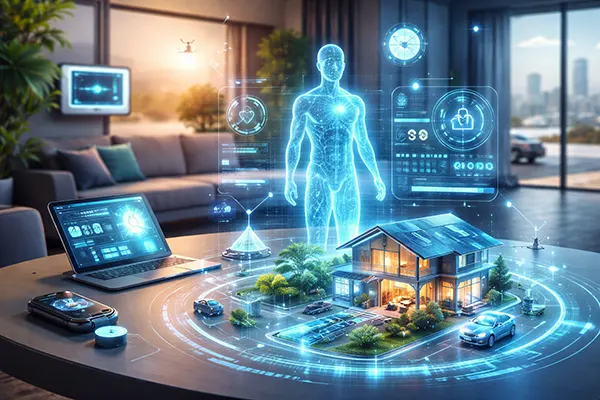
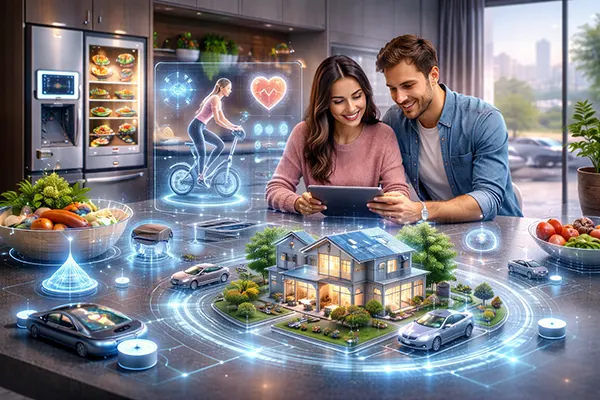
One example can be found in smart home ecosystems. Heating systems, air conditioners, lighting and appliances increasingly operate through interconnected sensors and controllers. A digital twin of the home environment can simulate temperature changes, energy consumption patterns and device usage. This allows systems to adjust settings automatically, reduce energy waste and maintain comfortable living conditions.
Another important aspect is the ability to test scenarios without affecting the real environment. Instead of experimenting with physical devices or settings, systems can simulate outcomes inside the digital model first. For consumers this reduces risks and improves efficiency. A household energy management system, for instance, can calculate how installing solar panels or adjusting heating schedules would affect electricity bills before the changes are implemented.
How Personal Digital Twins Are Emerging
Beyond homes and devices, researchers and technology companies are working on digital twins that represent aspects of human behaviour. These systems analyse data from smartphones, wearable devices and health trackers to create models of daily routines. The goal is not to replicate a person entirely but to build analytical models that help interpret behavioural patterns.
Health and wellness services provide some of the clearest examples. Fitness trackers and medical monitoring devices already collect detailed biometric data such as heart rate variability, sleep patterns and physical activity. When this data feeds a digital twin model, the system can simulate how lifestyle adjustments might influence long-term health outcomes. Some early medical research projects already use this approach to test treatment strategies virtually before applying them to real patients.
Financial and productivity tools are also beginning to adopt similar ideas. By analysing spending habits, commuting patterns or work schedules, software can generate simulations that help individuals evaluate decisions. For instance, a financial planning application may use a digital twin model of income and expenses to estimate how career changes, investments or savings strategies could affect long-term financial stability.
Technologies Enabling Consumer Digital Twins
The expansion of digital twins into everyday services is made possible by several technological developments that matured over the past decade. One of the most significant factors is the widespread adoption of Internet of Things devices. Smart thermostats, wearable sensors, connected appliances and environmental monitoring systems generate continuous streams of data that form the foundation for digital twin models.
Cloud computing infrastructure also plays a critical role. Digital twins require constant data processing, storage and simulation capabilities. Modern cloud platforms allow these calculations to occur in real time, even when large volumes of sensor information are involved. This infrastructure ensures that digital twins remain synchronised with the physical systems they represent.
Artificial intelligence and machine learning provide the analytical layer that turns raw data into predictive insights. Machine learning models analyse patterns, detect anomalies and simulate possible future outcomes. For consumers this translates into systems that can anticipate needs rather than simply react to commands.
Integration with Smart Ecosystems
Digital twins rarely operate as isolated tools. Their usefulness increases when they integrate with broader digital ecosystems that combine multiple services. Smart cities provide a good illustration of this trend. Urban planners increasingly build digital twins of neighbourhoods to analyse traffic flows, energy consumption and environmental conditions. Some of these insights are now reaching consumer services such as navigation apps and public transport planning tools.
Mobility services are another area where digital twins are becoming practical. Connected vehicles already generate extensive operational data. By creating digital models of vehicles and driving behaviour, systems can predict maintenance needs, optimise routes and improve safety features. Some insurance companies have begun exploring digital twin data to create usage-based pricing models that better reflect individual driving patterns.
Retail and e-commerce platforms are experimenting with digital twins of supply chains and customer behaviour. These models allow companies to forecast demand more accurately and manage inventory more efficiently. For consumers the visible result may be more accurate delivery estimates, better product availability and personalised recommendations based on realistic behavioural models.
Challenges and Ethical Questions Around Personal Digital Twins
Despite their potential benefits, digital twins raise several important questions related to privacy, transparency and data control. A digital twin relies on detailed information about devices, environments or personal behaviour. Without strong safeguards, such systems could collect and process sensitive data in ways that users do not fully understand.
Regulators and technology companies are increasingly addressing these concerns. In the European Union, data protection frameworks such as the General Data Protection Regulation require clear consent, transparency and strict limits on data usage. Many digital twin services therefore focus on anonymisation, local data processing and user-controlled privacy settings.
Another challenge involves accuracy and reliability. A digital twin can only produce meaningful predictions if the data feeding the model is reliable. In consumer environments where sensors may be imperfect or incomplete, systems must account for uncertainty. Developers increasingly incorporate verification mechanisms and confidence indicators to prevent misleading recommendations.
The Future of Digital Twins in Consumer Services
Looking ahead, digital twins are likely to become more common as connected devices continue to spread throughout homes, cities and personal technology ecosystems. Analysts expect that future consumer services will rely on increasingly detailed simulations that combine data from multiple sources. This could allow systems to coordinate home energy use with local electricity grids or synchronise personal mobility options with real-time city infrastructure.
Advances in edge computing may further accelerate adoption. Instead of sending all data to remote servers, processing can occur directly on devices such as smartphones, home hubs or local network controllers. This approach reduces latency and improves privacy by keeping sensitive data closer to the user.
Ultimately the success of consumer digital twins will depend on whether they deliver practical value without compromising trust. If implemented responsibly, these systems could help households manage energy, health and daily logistics more effectively. The concept that once belonged exclusively to industrial engineering may soon become a routine component of everyday digital services.