Geothermal Energy from Ultra-Deep Wells: Technical Barriers and Economics (2026)
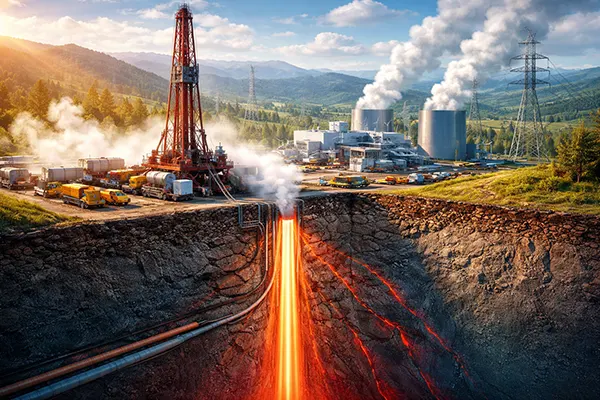
Ultra-deep geothermal aims to turn the Earth’s heat into predictable, round-the-clock electricity and industrial-grade heat in regions that do not have “easy” hydrothermal reservoirs. By 2026, the field has moved beyond purely theoretical discussions: enhanced geothermal systems (EGS) borrow horizontal drilling and completion practices from oil and gas, while closed-loop concepts have reached meaningful commissioning milestones in Europe. Even so, going from “deep” to “ultra-deep” introduces a different class of engineering problems—temperature-driven tool failure, long-term well integrity under extreme thermal cycles, and project costs that can surge if drilling and flow testing do not meet assumptions.
What “ultra-deep” changes in the subsurface: heat, pressure, and uncertainty
Depth is not just a number on a drilling report; it multiplies temperature, pressure, and operational risk. Conventional geothermal typically targets permeable formations where hot water already circulates. Ultra-deep approaches aim for hotter, tighter rock where permeability is limited and must be engineered, shifting the challenge from “finding a reservoir” to “creating a productive heat-exchange system.” That shift changes both the technical workflow and the project risk profile from the earliest planning stages.
In practice, the biggest uncertainty is the interaction of the local temperature gradient, in-situ stress, and how the rock responds when engineers try to establish stable flow paths. Even strong pre-drill models can be undermined by local geology: drilling rates can fall, instability can appear, and loss zones can consume time and materials. Because each additional drilling day carries high fixed costs, uncertainty is not an academic detail—it is a direct economic driver.
The resource promise is still compelling. Hotter rock can support higher enthalpy and can improve surface conversion options, especially when a project can deliver consistent temperature and flow. But the cost of accessing that heat rises sharply when specialised drilling tools, high-temperature completions, or repeated sidetracks become necessary. This is why ultra-deep geothermal economics are inseparable from drilling performance and reliability.
Reservoir creation: EGS, closed-loop, and the “it must flow” problem
Two main approaches dominate next-generation geothermal discussions. EGS seeks to create a connected fracture network between injection and production wells in hot, low-permeability rock. It borrows stimulation logic from shale operations but must adapt it for higher temperatures, longer project lifetimes, and stricter public acceptance conditions. Closed-loop systems aim to circulate a working fluid through sealed wellbores and laterals to pick up heat conductively, reducing dependence on natural permeability and limiting direct interaction between fluids and the formation.
By 2026, there are practical signals that operational improvements from oil and gas can translate into geothermal execution. Developers that use horizontal wells and repeatable pad drilling have reported meaningful reductions in drilling time across successive wells—an important factor because geothermal’s upfront cost base is heavily dominated by drilling and well construction. When drilling time falls without sacrificing well quality, both the levelised cost and financing risk can improve.
Closed-loop concepts have also progressed from prototypes towards grid-connected reality, at least in pilot contexts. That matters because closed-loop geothermal is often judged on whether it can deliver stable thermal performance without requiring an engineered fracture network. One project does not settle every technical debate, but a successful commissioning and grid connection is a concrete step in de-risking the category.
Well construction at extreme temperatures: where the hardware starts to fail
Ultra-deep wells push every component toward its limits: metallurgy, elastomers, cement chemistry, downhole electronics, and even measurement reliability. At elevated temperatures, standard motors, sensors, and telemetry degrade faster; seals may lose integrity; and drilling fluids must balance cooling needs with rheology, cuttings transport, and formation stability. The result is a toolchain problem: the entire drilling and completion system must operate reliably in conditions that exceed common oil-and-gas temperature envelopes.
Well integrity becomes a first-order economic variable, not a compliance checklist. Cement must survive thermal cycling; casings must handle combined loads over long periods; and corrosion or scaling risks depend on fluid chemistry and operating regime. If a project must rework a well because of cement failure, casing issues, or stuck pipe, the “firm clean energy” narrative can break quickly—especially when wells are deep, complex, and slow to remediate.
Because conventional drilling methods may struggle to access superhot conditions efficiently, several groups have pursued new drilling approaches designed to change the speed-to-depth equation. Whether these become mainstream or remain niche, they highlight a central reality in 2026: the future cost curve for ultra-deep geothermal is tightly linked to advances in drilling physics, high-temperature materials, and tool reliability.
Operational bottlenecks that drive costs: drilling days, completions, and flow testing
In geothermal, the commercial value of a well is not proven when the bit reaches target depth—it is proven when the well can be completed, controlled, and tested with stable temperature and sustainable flow. That makes completions and flow testing disproportionately important. A well that reaches the target but cannot sustain production because of weak connectivity, excessive fluid losses, or rapid scaling becomes a sunk cost rather than an asset.
EGS adds a further layer of complexity. Stimulation design, monitoring, and operational “traffic-light” protocols are typically necessary to manage induced seismicity risk. Even when the technical plan is sound, permitting timelines and public acceptance can become schedule risks. The upside is that EGS can leverage mature service capabilities—directional drilling, completion engineering, and real-time diagnostics—to improve repeatability and industrialise execution over time.
Closed-loop systems avoid some reservoir uncertainties but still face drilling complexity (multiple laterals), thermal modelling challenges, and the need to prove performance durability. In economic terms, the question becomes whether the thermal output per metre of well and the long-term stability of heat extraction can justify the extra drilling complexity and capital intensity versus competing firm power alternatives.
The 2026 economics: what makes a project bankable, and what still breaks the business case
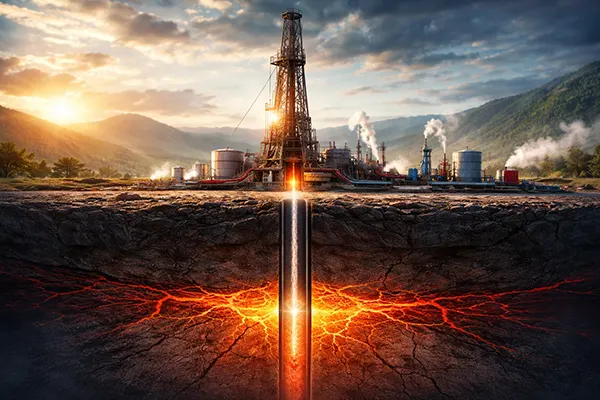
Ultra-deep geothermal is often described as firm, low-carbon energy, but financiers focus on a narrower test: can the project predict cost, schedule, and output well enough to support long-term offtake and non-recourse debt? Bankability depends on reducing subsurface uncertainty, demonstrating repeatable drilling and completion performance, and providing credible production forecasts backed by measured test data rather than optimistic modelling.
The cost stack is shaped by three major levers. First is drilling performance: metres per day, tool life, and avoidance of unplanned events. Second is subsurface success: achieving temperature and sustainable flow without unacceptable water demand or seismicity issues. Third is surface integration: whether the project sells electricity, heat, or both, and how efficiently it connects to grid infrastructure or industrial heat demand. If these elements align, geothermal can compete as a dependable source rather than a weather-dependent one.
What still breaks the business case is usually one of a few familiar patterns: drilling takes far longer than planned, a well needs expensive remedial work, flow testing underperforms, or permitting delays inflate financing costs. This is why many developers in 2026 emphasise standardised well designs, pad-based execution, and learning-curve effects—treating geothermal development more like repeatable manufacturing than bespoke exploration.
How costs can fall: learning curves, oil-and-gas transfer, and smarter risk allocation
The most credible cost-reduction pathway is operational learning: doing similar wells repeatedly and improving speed and reliability. Horizontal drilling, improved bit selection, better temperature management, and more disciplined logistics can reduce cycle time. If the reduction is sustained across multiple wells—not just a single standout well—the economics can change materially because drilling is the largest cost line in most deep geothermal projects.
Technology can also reshape the cost curve when it changes fundamental constraints. If a method reaches hotter rock faster, fewer wells may be required for the same thermal output, and surface equipment can be utilised more efficiently. High-temperature toolchains, improved cements, and more robust downhole electronics are less glamorous than headline-grabbing concepts, but they are often the difference between a bankable plan and a high-risk demonstration.
Finally, bankability improves when risks are allocated to parties best able to manage them. That can mean staged financing tied to drilling milestones, insurance structures that cover parts of resource risk, and offtake terms that ramp with demonstrated performance. In plain terms, ultra-deep geothermal in 2026 is not only an engineering challenge—it is a risk-management discipline where technical credibility and commercial structure must reinforce each other.